
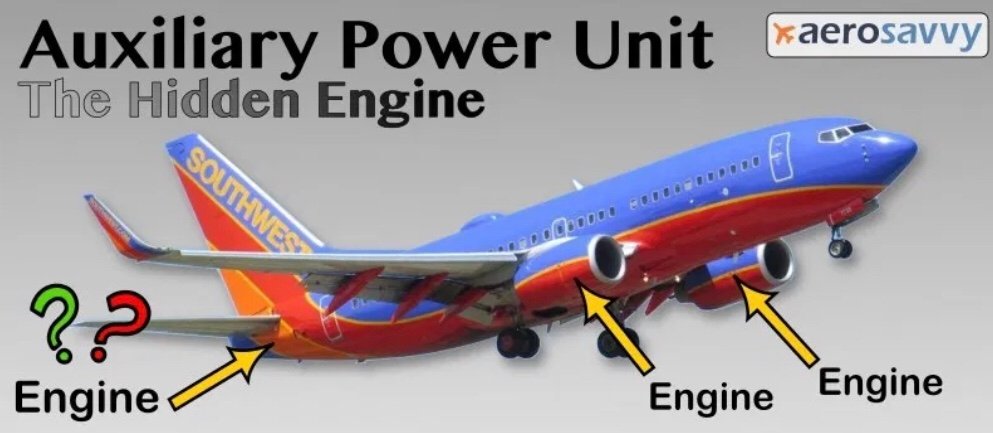
How many turbine engines are on an Airbus A320? Two, right? Would you believe three?
How about a Boeing 747? Four engines? Wrong again. A 747 has Five turbine engines!
Hiding inside the tail of almost every airliner is an extra engine called an Auxiliary Power Unit or APU. It is a turbine engine that generally sits in the tail of the aircraft. It’s purpose is to provide essential electric, pneumatic, and hydraulic power to the aircraft’s systems when the engines are not running,
Operation & Function
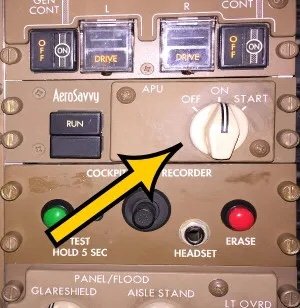
The APU is small enough to be started electrically and works like any jet engine. It takes in air, compresses it, adds a fuel mixture and ignites it. The power from the battery or an electric ground power cart would be used to spin up the APU by its electric starter motor, and then introduce fuel into it once its spinning fast enough, just like a jet engine is started. Once started, the APU powers both an electrical generator and an air compressor. The generator powers cabin lights and flight-deck avionics. Bleed air from the compressor powers air conditioning packs, providing either hot or cold air, and most importantly, provides the needed compressed air to get the engines started.
credit: aerosavvy.com
Startup is as easy as starting a car. Crews normally run the APU before flight for electrical power, air conditioning and engine start. After landing, the APU is started so engines can be shut down as soon as the aircraft arrives at the gate.
Safety & Redundancy
The most important job for the APU is to provide redundancy (backup). The APU’s electric generator can be used during flight in case the aircraft’s main generators within the engine have a problem. In case of a malfunction, the APU can provide compressed air for cabin pressurisation and airframe ice protection. The redundancy provided by the APU is one of the reasons twin engine jets are allowed to fly long distances over the ocean. It’s a pretty big job for a small turbine engine hiding in the tail.

credit: aerosavvy.com
The air intake and exhaust ports of the APU are usually located at the tail-cone of most aircraft. This is usually why you may notice heat coming out of the tail-cone when the aircraft is parked at the gate. However, on a particular aircraft where the APU is located elsewhere, the APU’s air intake and exhaust ports will vary.
Archived image unavailable.
credit: aerosavvy.com
Hotel Mode
Hotel mode is a feature on ATR 42/72 turboprops replacing the APU by locking the right-hand #2 engine with a “propeller brake” while allowing the turbine, and therefore also the generator, to run, providing electrical power and bleed air. This feature replaces the APU, saving weight. The video below shows the propeller engine starting up in hotel mode.
video credit: youtube.com
Next time you hop on an airliner (even a small regional jet), listen carefully as you board. You’ll hear the familiar whine of a turbine engine, even though the main engines aren’t running. You’re hearing the APU doing its job!
Sources:
Cover Photo Credit: https://aerosavvy.com/auxiliary-power-unit/
https://www.google.com/amp/s/thepointsguy.com/news/what-is-the-apu/amp/